News & Blog
Behind the scenes of Jung Sky's sales and operations team

The following content was originally published on 2nd of Febuary 2026, by Avioradar.net. The author of the article is Bruno Habus.
------
For the wider public, business aviation often remains hidden behind a curtain of discretion, private terminals, and aircraft that appear and disappear without much attention. Behind this seemingly simple world lie complex operational and market mechanisms, entire teams of people, and day-to-day decisions that allow no margin for error. That is precisely why we decided to visit Jung Sky, a Croatian business aviation operator that has for years been operating almost exclusively on the international market.
Jung Sky is a company that does not seek the spotlight, yet behind it stands considerable experience, a stable reputation, and operations stretching across Europe. Its aircraft rarely fly the same route two days in a row, and the business unfolds at a pace dictated by brokers, passengers, weather conditions, and air traffic, often all within the same day.
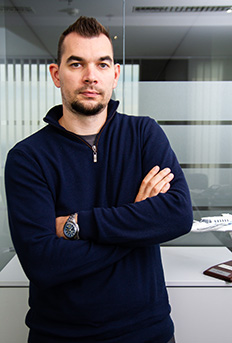
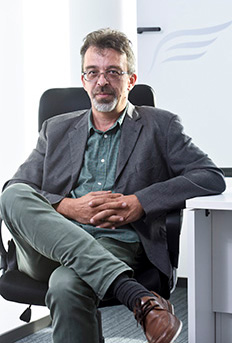
In their offices, we were welcomed by a positive, open, and highly communicative team. A conversation with Ivan Jakovac, Head of Sales, and Darija Janković Šprajc, Head of the Operations Control Center, quickly moved beyond the usual questions about flights and the market. Instead, it opened into a detailed insight into what is rarely seen: how a business aviation flight is actually sold, who the real clients are, what flight preparation looks like behind the scenes, and why sales and the operations center are two equally important, yet largely invisible, pillars of the entire system.
How a Business Aviation Flight Is Sold: Brokers, the Market, and Jung Sky’s Real Clients
In business aviation, passengers rarely purchase a flight directly by themselves. Although at first glance it may seem like an individual, almost personalized service, the reality is far more professional, structured, and intermediary-driven. At Jung Sky, flight sales begin where the traditional understanding of airline sales ends, on the broker market.
Ivan Jakovac, Head of Sales at Jung Sky, explains that the first contact with the company can also come by phone or email, particularly from clients who have heard of Jung Sky through recommendations or media exposure. Nevertheless, by far the largest number of inquiries arrives through Avinode, a global platform that brings together certified business aircraft operators and brokerage houses.
Avinode, as Jakovac describes it, is essentially a stock exchange for business aviation. “A broker needs a flight from, say, Munich to London. They enter the request into the system, and the platform automatically lists all operators who can technically and operationally perform that flight. The broker then decides from whom to request a quote, sometimes it's from one or two operators, and sometimes from twenty, thirty, or even more.”
At that point, Jung Sky becomes just one of many potential providers. Brokers collect offers and, based on them, assemble a package that they present to the end client - the passenger. Price is an extremely important factor, often a decisive one, but it's not the only one by all means. Safety, aircraft type, level of service, flexibility, and the operator’s reputation regularly influence the final decision.
Jakovac openly acknowledges what is widely known within the industry: in a large number of cases, the cheapest offer wins the job. However, this is not a rule without exceptions. There are situations in which a client consciously chooses a more expensive option because the aircraft type, crew experience, or operator reliability suits them better. It is precisely within this space that Jung Sky positions itself, with a reputation built over 16 years of operating in business aviation.

Although there is a perception that passengers contact operators directly, the reality is different. At Jung Sky, only two to three percent of flights on an annual basis come from direct clients. These are mostly long-standing customers from Croatia, the United States, or Canada, but the entire business model relies on a B2B relationship with brokerage companies.
The reason for this is straightforward: brokers take on a significant portion of the communication and filtering of requests. They understand what an operator can offer, know the market, and have a clear grasp of limitations and realistic expectations. In doing so, they relieve both the operator and the passenger. For Jung Sky, such a model is far more efficient than working directly with end users.
“Our primary clients are brokers. They know what they’re looking for, they contact us, we agree on all the details with them, and in the end they’re the ones who pay us. For us, that’s a much cleaner business,” Jakovac emphasizes.
The scale of sales activity is measured in thousands of inquiries. Throughout 2025, Jung Sky processed a total of 113,950 inquiries, which averages out to approximately 312 inquiries per day. However, this figure does not fully reflect the true dynamics of the business, as business aviation fluctuates significantly throughout the year. During certain peak periods, such as the first week of July, the daily number of inquiries climbed to as many as 750.
Jakovac stresses that speed of response, knowledge, and experience are crucial in such an environment. In a world where a broker is simultaneously waiting for dozens of quotes, an operator who is late or does not respond quickly enough often drops out of consideration altogether, regardless of price or service quality.
At the same time, a large proportion of these inquiries never materializes. “A lot of it comes down to market testing. Brokers are looking for information, comparing prices and options, and only a smaller share of requests ends up becoming an actual flight,” Jakovac explains. On an annual basis, Jung Sky operates around 700 to 750 flights, which on average translates into roughly one flight per aircraft per day. However, even this statistic can be misleading, both due to scheduled aircraft maintenance and the strong seasonality of the business. “In summer, we can operate three to four flights per aircraft per day, while in winter we fly significantly less.”
The passenger profile clearly illustrates just how international business aviation is. More than 95 percent of Jung Sky’s flights take place on routes that have no connection to Croatia, neither as point of departure nor as destination. Croatian passengers account for less than one percent of the total. The largest share of passengers comes from the United Kingdom, Germany, and the United States.
A particularly interesting segment care the American passengers. “It may sound unusual, but Americans make up a large part of our clientele, especially during the summer,” Jakovac says. “They see Europe as one large destination. They arrive in Frankfurt and then spend a month or two travelling across Europe.”
During these “European tours,” Jung Sky often plays a role by transporting passengers between tourist and business destinations. “Split, Dubrovnik, and Zadar are frequent points, along with Venice, Nice, Rome, Sardinia, Athens, and the Greek islands in general,” he adds. Such passengers are also characterized by the large amount of luggage they carry, which can pose a challenge in smaller business aircraft. Jakovac laughingly describes situations in which loading luggage turns into a real logistical game of “Tetris,” despite the fact that the sales team collects information about baggage in advance and alerts the crews accordingly.
It is also interesting that some of these passengers return. “Some become attached to a particular crew or aircraft and request to fly with them again the next time. If necessary, they are even willing to move their travel date to get the same combination. That tells you a lot about how important the relationship between crew and passengers is. It's almost just as important as the technical aspects of the flight,” Jakovac explains.
Brokers remain the central point of the entire system. Jung Sky works with several hundred brokerage companies and, over the course of a year, actively signs contracts with around 250 of them. Most brokers come from the United Kingdom, particularly London, followed by France, Germany, Italy, and Switzerland. Before the war, Ukraine, the Czech Republic, and Poland were also strong markets, but traffic from those regions has since declined significantly.
Jakovac emphasizes that the B2B model in business aviation is far more efficient than a B2C approach. Brokers take over the more demanding part of communication with passengers, filter requests, and send clearly defined inquiries to the operator. This allows Jung Sky to focus on what it does best - safe and reliable flight execution.
Contracts within this system are concluded quickly. Once a broker accepts an offer, communication continues via email, sometimes with brief negotiations, and a separate contract is signed for each individual flight. Prices are generated automatically based on a series of parameters: aircraft location, base, distance, airport fees, seasonal charges, and regulatory costs. In simpler cases, a price can be defined within seconds, which is essential given the volume of inquiries.
However, sales in business aviation are rarely linear. Passenger changes, shifts in departure times, additional requests, and last-minute modifications are part of everyday reality. This is precisely where the transition from sales to OCC begins. It's the moment, as Jakovac puts it, order must be created out of chaos.
The Operations Control Center as the Central Nervous System: From Flight Confirmation to Crew Accommodation
Although sales' involvement doesn't end completely when a flight is confirmed - because active communication with brokers regarding various flight-and passenger-related details can continue almost right up to departure, responsibility gradually shifts to the Operational Control Center.
In business aviation, there are no flight schedules planned months in advance, no fixed rotations, and no predictable patterns. Each flight is a new project, often with challenges entirely different from the previous one.
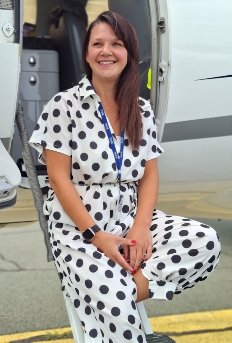
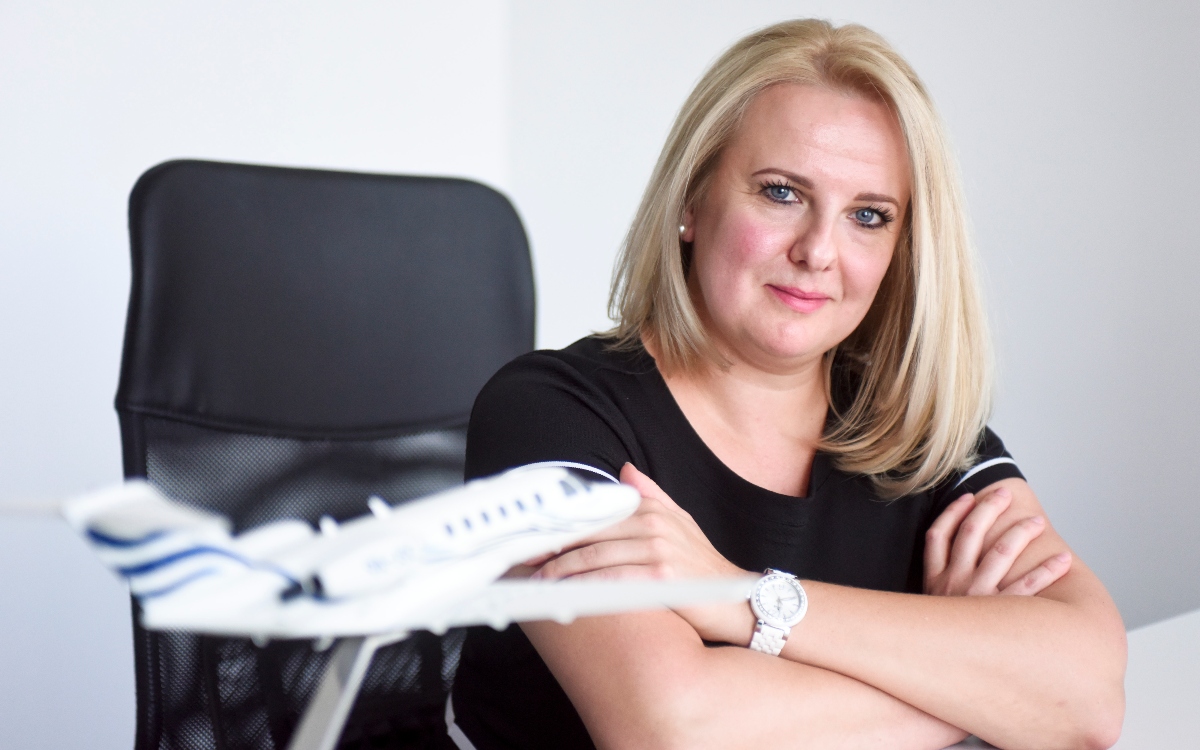
Darija Janković Šprajc, Head of the Operational Control Center, explains that Jung Sky’s OCC is a small team, but one with an exceptionally broad range of responsibilities. The department currently consists of three people, with a fourth joining soon, as one colleague from sales is undergoing OCC training. Their task is to cover everything regarding their flight operations, around the clock. While they record far fewer night flights today than in the past, the overall workload has been steadily increasing in recent years.
Unlike large commercial airlines, where operations are divided into highly specialized departments, business aviation OCCs handle almost everything. In practice, this means that the OCC truly functions as the central nervous system of the entire company.
“There’s no luxury of saying ‘that’s not my department.’ We coordinate ground operations, fuel, crew control, crew accommodation, communication with airports, aviation authorities, and everything in between,” Darija explains. “Colloquially speaking, we’re jacks of all trades.”
The key tool in this process is the Leon scheduling system. It contains a complete overview of operations - from confirmed flights, to those still in the quotation phase, as well as aircraft and crew availability. “We all work from the same system and see the same data. Without that, this kind of operation simply wouldn’t be possible,” says Darija. It is also important that the OCC can see flights that have not yet been officially confirmed, allowing the team to form a mental picture of the upcoming schedule and making later organization significantly easier.
Serious operational work begins the moment sales sends the flight confirmation. “That’s when the real work starts. We check crew availability, assign the aircraft registration, analyze airports, restrictions, performance, and any special permits,” Darija explains. Each flight goes through a series of checks, from runway length and airport elevation to aircraft weight calculations and baggage assessment.
“Sometimes we have to inform brokers that, unfortunately, we cannot accept all passengers because performance limitations don’t allow it. These are situations passengers don’t like of course, but safety and technical constraints always come first,” she emphasizes.
Flight planning is one of the most critical and responsible parts of the job. At Jung Sky, the OCC prepares and files flight plans independently, and all OCC members are licensed flight dispatchers.
“Every plan is reviewed with the captain, and that relationship has to be based on maximum trust,” Janković Šprajc stresses. Particular attention is paid to fuel calculations, weather conditions, and alternate airports. If there is even the slightest doubt, we repeat the calculations. “If something is borderline, we again redo the calculations and go through everything again with the crew. That’s our daily practice,” she adds.
One of the biggest challenges in operations is the sheer number of airports. Jung Sky has between 250 and 300 airports in its database, but that does not mean they are all equally familiar or easy to operate. “That’s far too many to know by heart. Even today, airports we're dealing with for the very first time regularly come up,” Darija says, pointing out France as particularly fertile ground for such situations.
Not all airports can accommodate business aviation. “For example, we cannot land at Charles de Gaulle or Heathrow, not because they’re expensive, but because they lack the infrastructure and procedures for business aviation,” she explains. On the other hand, there are airports almost entirely adapted to business aviation - smaller, uncongested, and with minimal procedures. “These are small ‘walk-in’ airports where a passenger can go from the entrance to the aircraft in ten minutes. Our clients value that immensely.” Still, Jung Sky does not avoid major hubs such as Munich or Frankfurt, which have developed procedures and dedicated business aviation terminals.
Slots are a story in themselves. Contrary to common perception, business aviation does not enjoy any special treatment. “When it comes to slots, the same rules apply to us as to major airlines,” Janković Šprajc says. She even feels that business aviation is sometimes treated more strictly. When congestion builds up, priority is more often given to large commercial aircraft carrying hundreds of passengers than to small business jets.
That said, the flexibility of smaller aircraft can sometimes work in their favor. “In approaches to major airports, we’re sometimes ‘pushed’ ahead because we’re smaller and faster. In those situations, we can save ten or fifteen minutes,” she explains.
A significant portion of coordination also involves working with ground handlers. Jung Sky has long-term contracts with many of them, which greatly simplifies operations. Handlers are familiar with the aircraft, the crews, and the company’s way of working, and they often take over slot coordination as well. This allows the OCC to resolve multiple operational elements through a single request, from parking positions to landing permits.
Communication with crews before departure is intensive, but once the flight is airborne, options become limited. When pilots switch off their mobile phones, the only way to communicate is through air traffic control, via urgent messages. This system provides no direct feedback and relies on the discretion of controllers, which further highlights the importance of flawless preparation before takeoff.
Despite all this, unforeseen situations are part of everyday life. Technical issues, weather changes, or airport closures occur regularly. “That’s aviation, that’s what it’s all about,” Janković Šprajc says. Jung Sky’s advantage lies in flexibility: a smaller fleet allows one aircraft to be reassigned to cover part of another’s operation in case of problems, avoiding the need for expensive external replacements.
When more serious disruptions occur, communication becomes crucial. The OCC and sales work together to find solutions - shifting departure times, selecting alternate airports, or sourcing a replacement aircraft. The goal is always the same: to get the flight airborne and to provide the client with a solution they can accept.
Safety, Alternates, and People: When Plans Don’t Survive Reality
No matter how thorough the preparation, business aviation does not know perfectly stable days. Weather changes, technical irregularities, airport restrictions, or air traffic regulations regularly disrupt even the best-laid plans. One concept that often causes discomfort among passengers, but has a very precise meaning in operations, is diversion to an alternate airport.
Darija Janković Šprajc openly says that alternates are significantly more common in winter than in summer, primarily due to stricter meteorological minima that must be respected. “We plan alternates in advance, and whenever possible we try to keep them as close to the destination as we can. That’s a normal process for every flight. Any flight, at any moment, can end up at an alternate,” she explains.
In practice, this means that the OCC must be prepared not only for the technical aspect of landing at an alternate airport, but also for everything that follows - transfers, waiting times, and even a subsequent repositioning flight to the original destination once conditions improve. “We’ve had situations where we stayed at an alternate and later, when the weather improved, flew the passengers on to their destination,” Janković Šprajc says.
From a sales perspective, situations in which a flight ends up at an alternate airport are extremely sensitive. “Nobody is happy about them. Nor the passengers, nor the crew, nor the OCC, and certainly not us in sales. But it’s part of the reality of this business,” says Jakovac. The key difference, he adds, lies in experience. Experienced brokers understand what an alternate means and accept it as part of the safety system, while less experienced ones may react with panic and unnecessary drama.
“Good flight planning means safety. That’s something the company insists on without any compromises,” Darija emphasizes. Additional weight is given to this by the fact that the company owner is also an active captain. “Safety is absolutely at the top of our priorities.”
Technical issues, crew illness, or sudden air traffic regulations regularly test the system’s flexibility. Jakovac points out that business aviation does not enjoy the comfort that large airlines do. “We don’t have the luxury of telling a passenger: you’ll fly tomorrow. Our passengers would remember that, and bad word-of-mouth is the last thing you want in this business.” In such moments, speed of reaction and a willingness to offer solutions, often not financially ideal for the operator, are crucial.
In cases of technical issues, which are sometimes discovered just minutes before departure, operations and sales work simultaneously on multiple solutions. “We’ve had situations where the crew decided an additional technical check was needed, which would take an hour or two. In the background, we’re already running all the options, looking for a replacement aircraft, while passengers are accommodated in a VIP lounge at the company’s expense,” Jakovac describes. “If necessary, we find a replacement aircraft, even though that often comes at a financial loss for us.”
In the long run, however, such an approach builds trust. In business aviation, one satisfied broker can bring dozens of flights per year, while a single serious failure can close doors permanently. “Everyone understands that an aircraft can be switched to AOG status, but they don’t understand if you don’t offer a solution,” Jakovac adds.
Behind all of this stands the operations center, which must maintain control even when the plan falls apart. Janković Šprajc describes how, in such moments, slots are shifted, parking positions secured, and new routings coordinated, all with one goal: to get the flight airborne as quickly as possible under conditions acceptable to the passenger.
People are a crucial part of the entire system. All members of Jung Sky’s OCC are licensed flight dispatchers, and obtaining that license requires serious preparation. “There are schools approved by the Croatian Civil Aviation Agency. After the theoretical part and internal exams, there’s a written and practical exam before the authority,” Janković Šprajc explains. “Depending on the pace, the training can be completed in three to four months, but the real thing begins once you enter the OCC's everyday activities. That's where you learn what everyday reality looks like.”
Only then does it become clear how demanding the job truly is and how many decisions must be made within very short timeframes.
Toward the end of the conversation, the focus returns to people and the personal experience of the job. When asked what excites her most about the work, Darija Janković Šprajc does not hesitate. “To do this job at a high level, it’s very important to have the support of your family and colleagues, because that’s the nature of this profession. But once you enter aviation, the adrenaline keeps you going. You always want to know more, try something new, and solve another challenge.”
Operational “headaches,” she says, are inevitable. “There’s constant pressure that everything has to be done immediately, accurately, and safely. In one moment a captain is calling about a plan change, in the next you have to refile a flight plan because an extra passenger has arrived. Everything happens at the same time, in a very short window.”
Jakovac agrees that adrenaline is the common denominator. “We’re all small cogs that have to keep turning for the system to function. Our biggest headaches are often tied to clients and their requests, especially when they’re not ready to accept limitations like slots or alternates.” Still, he adds, that expenditure of energy is part of the fuel that keeps them moving forward.
The conversation ends with praise for the crews. “They’re on the front line,” Janković Šprajc stresses. “They’re the ones passengers see, communicate with, and who ultimately shape the passenger’s final impression of the company. Their professionalism, composure, and attitude toward passengers are the reason clients come back.”
In the world of business aviation, where plans change hour by hour and decisions are made under pressure, it is people who hold the system together. What a passenger experiences as a routine flight is, for Jung Sky, always a new challenge, and a new confirmation that behind every takeoff lies far more than just an aircraft.
...
The conversation at Jung Sky clearly shows that business aviation has very little to do with superficial perceptions of luxury and comfort. Behind every flight stands a series of rapid decisions, coordination with dozens of external stakeholders, and a team of people who must function in perfect sync, often under time pressure and circumstances beyond their control. Sales and the operations center are inseparably linked within this system; one cannot exist without the other.
What remains most striking after the conversation is not only the volume of work or the complexity of operations, but the human dimension of the entire story. From relationships with brokers and passengers, to trust between dispatchers and crews, to the willingness to find solutions in crisis situations, even when that means additional effort or cost. In such an environment, reputation is not built through statements, but through everyday decisions.
The visit to Jung Sky confirmed that business aviation does not happen only in the air. It happens in offices, in the OCC, in constant communication, and in the people who accept that their work is dynamic, unpredictable, and demanding - but precisely because of that - deeply compelling. What a passenger experiences as routine is, for them, always a new project. And it is precisely in this daily readiness to turn complexity into simplicity that the essence of their work lies.
View previous news:
Recommendation:
Other:
Here, you book yourself the always interesting Jung Sky newsletter which keeps you in touch with all the nice things that are happening to us. Don't worry, we won't be a nuisance, smooth flying is the only way we roll.